Interview on far-right attacks on liberal democracy and identity politics in the Süddeutsche Zeitung
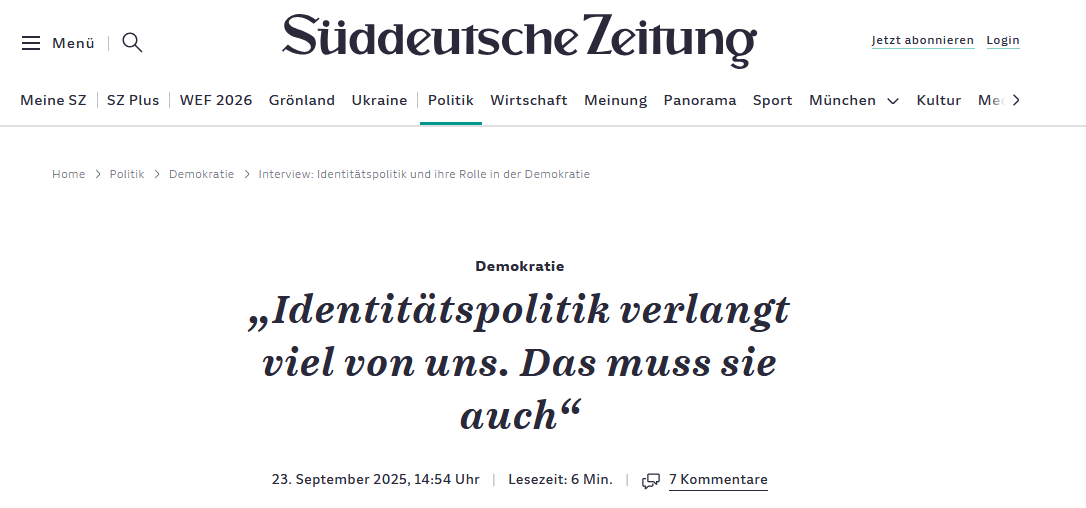
automatic translation
I gave the Süddeutsche Zeitung an extended interview about far-right attacks on liberal democracy and identity politics. The far right attacks identity politics because it stands for equal freedom—the core principle of liberal democracy. I argue that the far right translates the real problems of massive economic inequality into group-based hatred. To undermine the material foundations of far-right extremism, substantial wealth redistribution is essential.
Full interview: “Identity politics demands a great deal from us — and it has to.”
by Sebastian Gierke, 23 September 2025
Identity politics? Just over ten years ago, hardly anyone knew what was meant by it. That changed quickly; for a while it dominated the socio-political discourse. But very soon the pendulum swung back in the other direction. Today, identity politics serves many both as an explanation for the problems of the Left and for the success of the Right. Politicians such as Donald Trump court votes by criticizing “wokeness.” And yet it still exists—its defenders, too. For example, the political scientist and philosopher Karsten Schubert, who, against the trend, has written In Praise of Identity Politics.
In his spoken remarks, Schubert used gender-inclusive language; the Süddeutsche Zeitung adopted this. In this case, it is marked by a colon.
SZ: Mr. Schubert, how much blame does identity politics bear for the fact that it has ended up so much on the defensive?
Karsten Schubert: A negligibly small amount. Identity politics, correctly understood in democratic-theoretical terms, does not work in the way it is always criticized.
Could you explain identity politics, correctly understood in democratic-theoretical terms?
It is the shared political practice of structurally disadvantaged groups. It is directed against discrimination and thereby pursues the democratic promise of freedom and equality for all. In this sense, I understand identity politics as necessary for liberal democracy, which as a whole is currently under attack.
Precisely for that reason, wouldn’t it be better if liberal democracy as a whole defended itself—rather than only individual disadvantaged groups?
Recognizing and naming structural discrimination works better from the perspective of those who are disadvantaged than from that of the majority society. Identity politics is necessary to identify and correct blind spots in established knowledge.
That sounds almost harmless.
Identity politics demands a lot of us. It has to. It is about changing social norms that privilege some over others. These norms are also deeply inscribed in habits. Giving up privilege and changing habits triggers defensiveness. But that does not explain the massive resistance. What is central is which narratives political actors set in the discourse.
Which narratives are those?
There are two major poles of discursive mobilization against identity politics. On the one hand, the discussion takes place primarily in the cultural pages (the Feuilleton). For a long time, that sphere claimed a universalist authority to explain the world, which is challenged by the identity-political multiplication of voices. That is one explanation for the obsession there with the alleged problems of identity politics.
Do you really believe the Feuilleton has such a large impact across society at large?
How things are discussed in the media and in politics strongly shapes opinions. In the Feuilleton there is a cultivated anti-woke discourse that right-wing politicians then draw on.
That’s the second pole?
Exactly. Right-wing populists and far-right extremists agitate against identity politics, thereby calling into question the commitment to equal human dignity in general and attacking the foundations of liberal democracy. They also succeed because they pick up resentments in the center that the Feuilleton discourse has reinforced.
That makes it too easy for you. Criticism of identity politics catches on because its representatives have made mistakes.
But the repeatedly voiced criticism is wrong: identity politics does not restrict freedom; it realizes freedom for all. It does not harden identities; it transforms them. And it is not anti-universalist; it concretizes universalism. Hardening and fundamentalism can occur, but they are usually corrected and do not diminish the democratic contribution of identity politics.
Cancel culture, limiting debate through safe spaces, disinvited speakers—are those the kinds of hardenings you mean?
Individual cases are scandalized and made pars pro toto for identity politics as a whole. That identity politics is criticized as excessive is, incidentally, to be expected because it criticizes deeply entrenched norms. Much of what is self-evident today used to be considered an imposition—for example women’s suffrage or marriage equality. Looking back suggests a certain epistemic modesty and openness to the idea that we, personally and as a society, can still learn a great deal from identity politics.
But some cases are striking.
If you look closely at the constantly reproduced examples, something is almost always missing. They are distorting anecdotes in which certain aspects are omitted. If you research further, the criticism often turns out to be justified.
A current case: the ad campaign by U.S. actress Sydney Sweeney. It contains a pun on the similar-sounding English words “jeans” and “genes.” Critics say the campaign uses racist codes because it attests Sweeney, as a white woman, to having great genes.
I can understand the criticism of the implicit racism.
Donald Trump reacted immediately to the criticism—along the lines of: Are you no longer allowed to find a white woman beautiful?
That is a typical distortion: the criticism is not about such a restriction of freedom, which would indeed be intrusive. Rather, it is about the fact that advertising should not ironically latch onto racist thinking—good genes, bad genes.
But is this fight worth it?
What is remarkable is how the debate oscillates between fundamental criticism and strategic advice for the Left. On the one hand, it is said that identity politics is all-powerful and dangerous; on the other, that the Left is ineffective because of it and tears itself apart over “woke” side issues.
Trump has been given ammunition.
That he stokes the culture war is to be expected. The advertising’s irony fits the fascistic MAGA zeitgeist and right-wing online culture. There is no silver-bullet remedy. But if one refrains from justified criticism out of fear of right-wing reactions, one fulfills their goal. In the U.S., the discourse has become so brutalized that a president can score points with jokes about racism. That is the problem—not identity politics.
Are you sure? There are people, for example in the white U.S. working class, who feel culturally left behind. Then the identity politics of the university Left comes along and deepens the rift by issuing moral judgments.
Identity politics is complex and science-based. Its positions are not mere assertions; they emerge in exchange with research. Accordingly, it meets more understanding in progressive, educated milieus than in less-educated ones.
That is a problem—a problem of communication.
Identity politics has to face that, yes. It has to translate and explain well. But that is not the central problem.
So what is?
What is central is social inequality, which shows itself, among other things, in class-based unequal educational opportunities.
So the people who reject it simply cannot understand identity politics?
No—rather, the point is that the agitation against identity politics works because class and culture conflicts become entangled. In the U.S. this is particularly clear: in important positions sit college graduates with rather liberal values. In the lives of people without a degree, they appear everywhere as power—in school, at work, in the administration. They personify structural inequality. Trump represents the revolt against this class, the big “fuck you” to liberal elites. To deprive the right-wing culture war of its basis, we have to fight social inequality.
But it’s presumptuous to say that if everyone received better education, they would like identity politics.
That is not what I mean. Fundamentally, the question is: how far should identity politics change the majority toward a liberal way of life? That is a democratically complex question: which anti-discrimination norms should be generally binding in order to establish, as it were, a baseline—and which belong to a liberal-cosmopolitan way of life that should not be universalized, in order to preserve democratic pluralism?
For many, identity politics goes too far precisely there. They experience these demands as an attack on their own way of life.
The claim of identity politics is not to convince everyone of a particular lifestyle. An example: a conservative Christian family rejects its gay son. That identity politics opposes such discrimination—even in the private sphere—is justified. But that does not mean the family must give up its values and adapt to a queer lifestyle.
But that is exactly the demand that is made of them in such a case.
Protection against discrimination does not work without certain changes in the thinking of the majority. But I hold on to the distinction between morality and ethics: between universalizable norms and individual decisions about the good life, into which no one should govern. Where the boundary lies is part of the debates that identity politics sets in motion. Historically, it becomes clear that correcting this boundary has often been reasonable.
So identity politics does not rule out compromise after all? It is often claimed that it wants everything immediately—in language and in laws—for a small minority.
At its core, it is oriented toward communication: it is about being understood, including self-critical strategic debates. Recently, for example, the first trans member of the U.S. Congress said that trans activism in the U.S. had wanted too much at once, had acted too judgmentally, and thus had not brought society along. That is an important consideration. Regardless, the dehumanizing agitation by the MAGA movement is decisive for the massive trans hostility in the U.S.
Don’t both sides act similarly? The Right and the Left both rely on culture war, trying to gain power via cultural hegemony.
You can only see it that way if you understand politics as pure power struggle. But we live in a constitutional order of freedom in which human dignity, freedom, and equality have universal validity. Identity politics wants to realize these values better; the Right wants to prevent that. That is a crucial difference. And the Right seeks to destroy this framework.
Not right-wing conservatives per se, but far-right extremism aims at overcoming liberal democracy. Since liberal democracy and identity politics are two sides of the same coin, it is no surprise that the fight against identity politics is a central component of far-right ideology.
Are they succeeding?
That can happen—we are currently witnessing a fascistic erosion of the constitutional state in the U.S. Precisely for that reason, the equation of right-wing culture war and left-wing identity politics is so dangerous: it relativizes the universalism of liberal democracy.
How can identity politics get out of the defensive?
Right-wing politics translates justified dissatisfaction into dehumanizing resentments. Distributional questions are central here.
A plea for class struggle from an identity-politics advocate?
Think of the massive unequal distribution of wealth and the associated partial incapacity of the state to act. Opportunities for participation are also unequally distributed, and many no longer believe in the core premise of democracy: effective participation. Democracy is slowly slipping through our fingers. The struggles over identity politics are a symptom of that.
Cite and read
Schubert, Karsten/Gierke, Sebastian (2025): Interview: „Identitätspolitik verlangt viel von uns. Das muss sie auch“. Süddeutsche Zeitung, 24.09.2025, Politik, S. 5. https://www.sueddeutsche.de/politik/identitaetspolitik-wirkung-gesellschaft-li.3297423.
Related Posts
- Article in Ethics Journal on 'Democracy as an Open Form of Life', 26. July 2025
- Gefangen in der Totalität. Daniel Loicks Gegengemeinschaften sollten den liberalen Rechtsstaat verteidigen - Neue Rezension in 'Ethik und Gesellschaft', 27. May 2025
- In Praise of Identity Politics. Monograph published with C.H.Beck, 7. August 2024
- Special Issue: The Dissolution of the Liberal Consensus (ZfPT), 25. January 2024
- Identity politics and the democratization of democracy. Oscillations between power and reason in radical democratic and standpoint theory - New Article in Constellations, 4. October 2023